✨ #𝐀𝐋𝐀𝐒𝐍𝐆𝐁𝐀𝐘𝐀𝐍𝟐.𝟎 𝐂𝐎𝐍𝐓𝐈𝐍𝐔𝐄𝐒 𝐈𝐓𝐒 𝐉𝐎𝐔𝐑𝐍𝐄𝐘! Following its exhibition at the Polytechnic...
Read More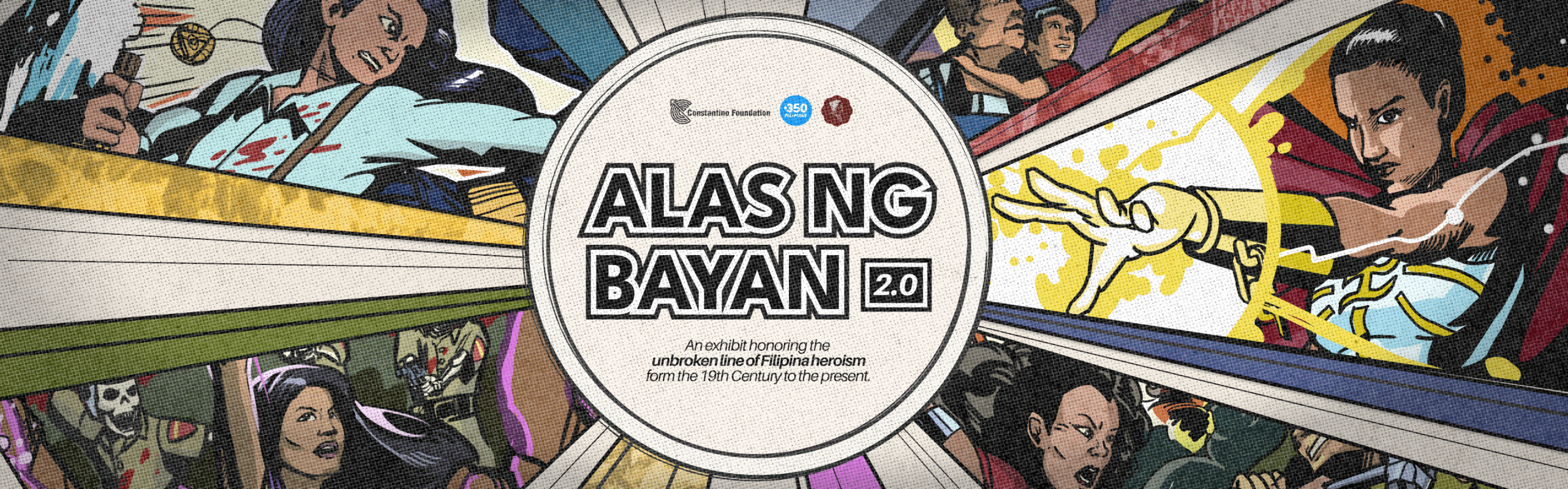
Revealing the Superpowered
Rio Constantino – Exhibit Curator, Biologist, Batman-in-training
This is an exhibit about memory, as well as the responsibilities of those inheriting that memory, told using a visual language that should be familiar to most modern audiences.
During the pandemic, Billy Pangilinan and I worked on the idea of transforming Filipina heroines into superheroines. I speak as if we gave equal contributions to the project, but really all the art is by him. My main role was to provide creative feedback. That, and to connect our efforts with prior endeavors: the Alas ng Bayan paintings, commissioned and first exhibited at the Constantino Foundation’s Linangan Gallery in 2019.
The paintings depict five exemplary Filipinas from more than a century of history: the revolutionary Gregoria “Oriang” de Jesus (1875 – 1943); Apolonia Catra (d. 1905), the only named woman officer of the Katagalugan Republic, and a figure feared by American soldiers; Remedios Gomez-Paraiso (1918 – 2014), also known as “Kumander Liwayway”; Maria Lorena Barros (1948 – 1976), founding chair of the Malayang Kilusan ng Bagong Kababaihan, or MAKIBAKA; and Gloria Capitan (1959 – 2016), the first recorded extrajudicial killing under Duterte, who had resisted the construction of a coal plant and open coal storage facility in her hometown of Barangay Lucanin, Mariveles, Bataan.
The exhibit was a means of counteracting the twin ills of climate change and national forgetting. It was also a way to help reverse the belittling which women have too often struggled against throughout history. Both were goals which Billy readily contributed his talents to.
All five Alas women led remarkable lives fighting injustice and oppression. All became intensely involved addressing matters that are still keenly felt today, such as global warming, LGBTQ+ rights, police impunity, and national sovereignty. (Some visitors may wonder what Oriang or Catra, living during the late 19th to early 20th centuries, had to do with the catastrophes imposed by fossil fuels. Remember, the steamships that brought colonial troops to the Philippines were powered by coal.)
But whereas the original paintings used the esoteric symbolism of tarot cards to explore the histories of Oriang and her peers, Billy drew on another font of inspiration for this second iteration of Alas ng Bayan: that of comics, also known as komiks, or in other regions as manga or manhwa.
The choice came naturally to us, being avid followers of anything involving science fiction or fantasy. Billy is a fan of DC and Marvel, meaning Superman, Wonder Woman, Iron Man, the X-Men. Both of us have read, and enjoyed, The Mythology Class by Arnold Arre. Then of course there’s the universal shōnen trifecta of Naruto, Bleach, and One Piece; as a high school student I also secretly read (because my teenage insecurity wouldn’t let it be known) the manga titled Maid Sama! More recently there’s been Dead Balagtas by Emiliana Kampilan, as well as Ella Arcangel by Julius Villanueva and Mervin Malonzo.
People of all ages still read comics today, because comics have power. They, like other forms of storytelling, serve as potent channels for learning and communion. What better way to convey social and ecological degradation than the diwata queen encountered by Ella Arcangel on a city street, the fairytale creature reduced by years of decay until its form resembled little more than an insectile husk? Similarly, what more eloquent manner of teaching the ethos required to escape our current crisis, than Ella herself humbly approaching a god of the earth, asking for its permission, on her community’s behalf, to literally continue living upon the guardian spirit’s afflicted back?
Sometimes fiction is so compelling it can leak into the real world. Inspect the photographs of protests in Indonesia, Nepal, Madagascar, Morocco, even right here in Metro Manila. Chances are you’ll see a badly drawn skull-and-crossbones flag marked by a straw hat, the banner of an anarchic pirate crew from the manga One Piece.
Ultimately, we wanted to avoid giving the Alas ng Bayan heroines any superpowers they did not already possess. Super strength, magic spells, energy beams – all these feats merely reflect character traits that Oriang and Catra, Kumander Liwayway, Maria Lorena Barros, and Gloria Capitan have always embodied.
I will admit that the factual reality of undead Philippine constabulary may not be supported by most textbooks. Then again, there are better questions to consider.
Why, for example, does Apolonia Catra wear the mystic necklace that she does? Why do Oriang’s powers revolve around light and the sun? Why is it, that despite shedding so much of their blood and tears, despite sacrificing their lives, that these women and many others like them feature so little in our national conscience?
Think on that. After all, who knows? Maybe soon a new legion of superheroes will be emerging from our ranks.
The Paintings
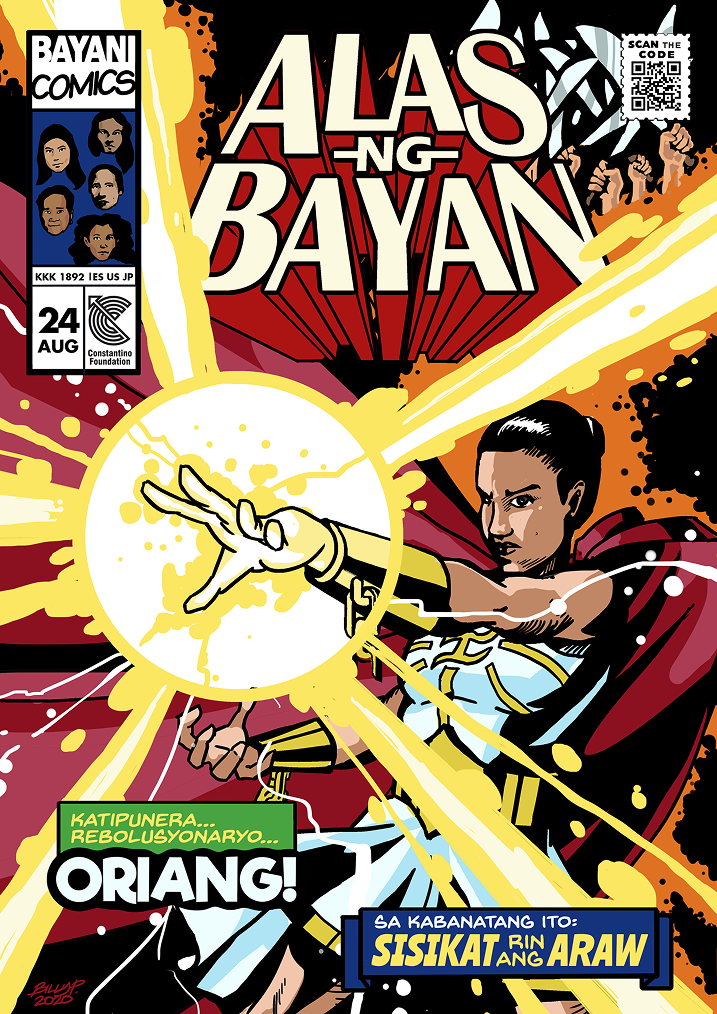
“Lakambini ng Katipunan”
Gregoria de Jesus
Gregoria “Oriang” de Jesus, also known as Lakambini, was deeply involved in the revolutionary war from around the time of the Katipunan’s founding in 1892 until the open uprising of 1896 and beyond. She, like other combatants during the revolution against Spain, were pioneers in the way they located violence against women at the center of the struggle for national liberation.
Symbols and References
- KKK 1892: The Katipunan was formed 1892; the Cry of Pugad Lawin erupted on August 24, 1896 (Note that the exact date has been strongly debated. We referred a lot to the works of Milagros Guerrero et. al. while making the posters, and she argues the correct date is August 24. However, other academics and institutions say the Cry happened on August 23.)
- HER YOUTH: Oriang is often depicted as a wise old woman. We consciously went against that. People forget that Oriang was an active participant during the revolution. She knew how to ride a horse, shoot a rifle, extract water from the sap of vines.
- HER CHESTPLATE: The symbol on Oriang’s chest isn’t the letter “I”, it’s the Baybayin letter for “Ka,” like what’s depicted on the flags of the Katipunan.
- BROKEN MANACLES: Oriang quite literally broke herself free from the chains of empire and oppression.
- BOLOS: Oriang didn’t stop at herself, however. She dedicated her life to liberating her fellow Filipinos and inspiring them to take up arms.
- THE SUN: The writings of the Katipunan, including works written by Bonifacio and Jacinto, constantly use the metaphors of light and darkness. For example, see this sentence by Jacinto:
“Hangang kailan, hangang kailan, mga tagalog, sisikat ang araw ng inyong lakas kasabay ng inyong kaginhawahan?”
Blind eyes, a slumbering country, and dawn’s golden rays once Filipinos cast off their chains and awaken; it all makes for stark, powerful imagery.
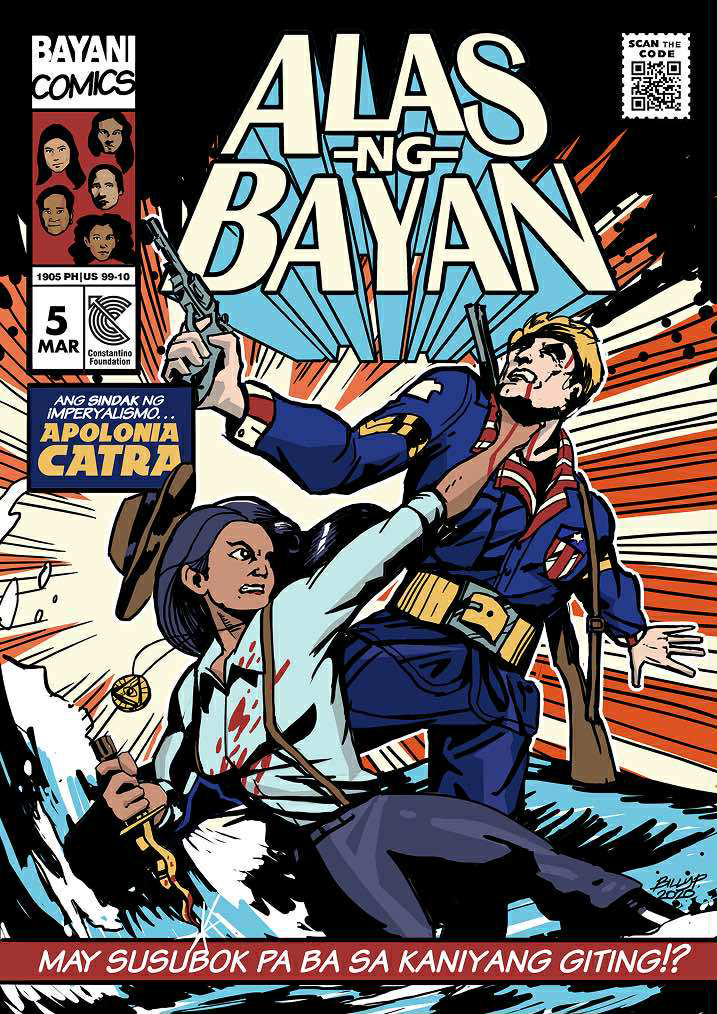
Apolonia Catra
Apolonia Catra is the only named woman officer in the armed forces of General Macario Sakay, President of the Tagalog Republic. Catra is a mystery; no photos of her have survived to the present day. However, we do know from news reports during the Philippine-American war that Catra was feared by the Americans as a revolutionary who “dressed in men’s clothing and was well known for her cruelty and reckless courage.” She was killed in action on March 5, 1905, after refusing to surrender to an enemy ambush.
Symbols and References
- 99-10: The Philippine-American War lasted from 1899-1910. Roosevelt declared the war was over in 1902, but violent resistance continued well after his proclamation.
- HER CLOTHES: Catra was famed for wearing men’s clothing.
- HER NECKLACE: Billy imagined Catra as a warrior who used magic equipment to fight her enemies. Hence her necklace, a mystic amulet (an anting-anting) which protected her against harm. Look at the symbol on the necklace; doesn’t it resemble the all-seeing eye used on the seals of the Katipunan and the Tagalog Republic?
- THE SUNBURST: Although the resemblance may be subtle, the sunburst framing Catra’s head was patterned after the flag of the Tagalog Republic.
- THE DAGGER, THE BLOOD, THE CHURNING WATER: Catra’s poster is perhaps the most violent out of all the Alas ng Bayan women, save for Kumander Liwayway. This was a conscious choice. Catra lived during an exceptionally violent time. The Americans were not peaceful “bearers of benevolence,” they were bloodthirsty imperialists, who put Filipinos in concentration camps when they refused to submit to the whims of foreign invaders.
- CAPTAIN AMERICA: It’s obvious who Catra’s opponent is supposed to represent. Note, however, the white skin and blond eyes. American empire was a racist empire, a fact recognized by African-American soldiers like David Fagen during the Philippine-American war. Fagen defected from the U.S. army and later attained the rank of captain after joining the ranks of Filipino revolutionaries.
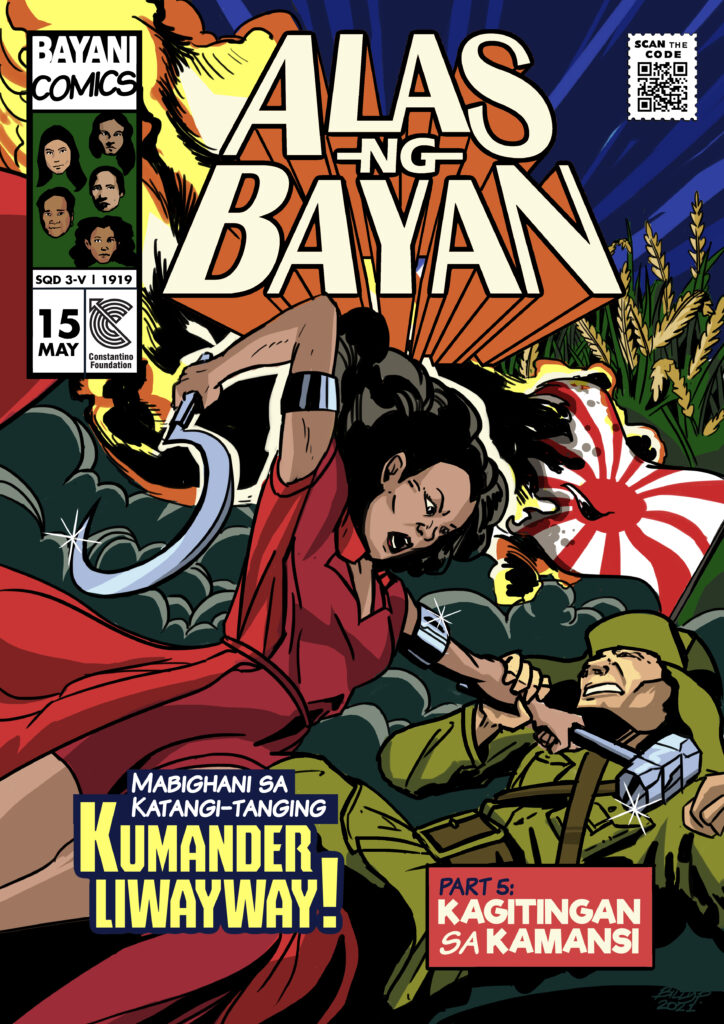
“Kumander Liwayway”
Remedios Gomez-Paraiso
Remedios Gomez-Paraiso (July 12 1919-May 15, 2014) was a guerilla who fought the Japanese occupation of the Philippines during World War II under the alias Kumander Liwayway. She was an officer of the Hukbong Bayan laban sa Hapon or Hukbalahap. After the war, she fought as an officer of the Hukbong Mapagpalaya ng Bayan (HMB) of the Partido Komunista ng Pilipinas (PKP-1938), this time with the U.S. supported Philippine Constabulary as her enemy.
When comrades criticized her for putting on makeup before battle, she replied, “One of the things I am fighting for in the Huk movement is the right to be myself.”
Symbols and References
- SQUADRON 3-V: Liwayway was born 1919 in the town of Mexico, Pampanga. After her father was executed by the invading Japanese, she joined the Huks, initially as a medic. However, her bravery and skill in battle quickly led to her becoming a commander of the armed Huk squadron named Squadron 3-V.
- MAKEUP: Kumander Liwayway made it a point to put on lipstick before every battle. When her comrades criticized her for doing so, she replied, “One of the things I am fighting for in the Huk movement is the right to be myself.”
- HER DRESS: Billy made an effort to illustrate Kumander Liwayway in period-accurate clothing. Accordingly, her beautiful red dress was based on the shirtwaist dresses popular during the 1940’s.
- KAGITINGAN SA KAMANSI: During the Battle of Kamansi, Liwayway and her comrades successfully defeated an enemy Japanese force despite being heavily outnumbered.
- THE HAMMER AND SICKLE: As part of Kumander Liwayway’s Huk training, she attended lectures about communism and historical materialism. Accordingly, after World War II she continued fighting under the HMB, this time to free Filipinos from the grasp of landlords and capitalists and American imperialists.
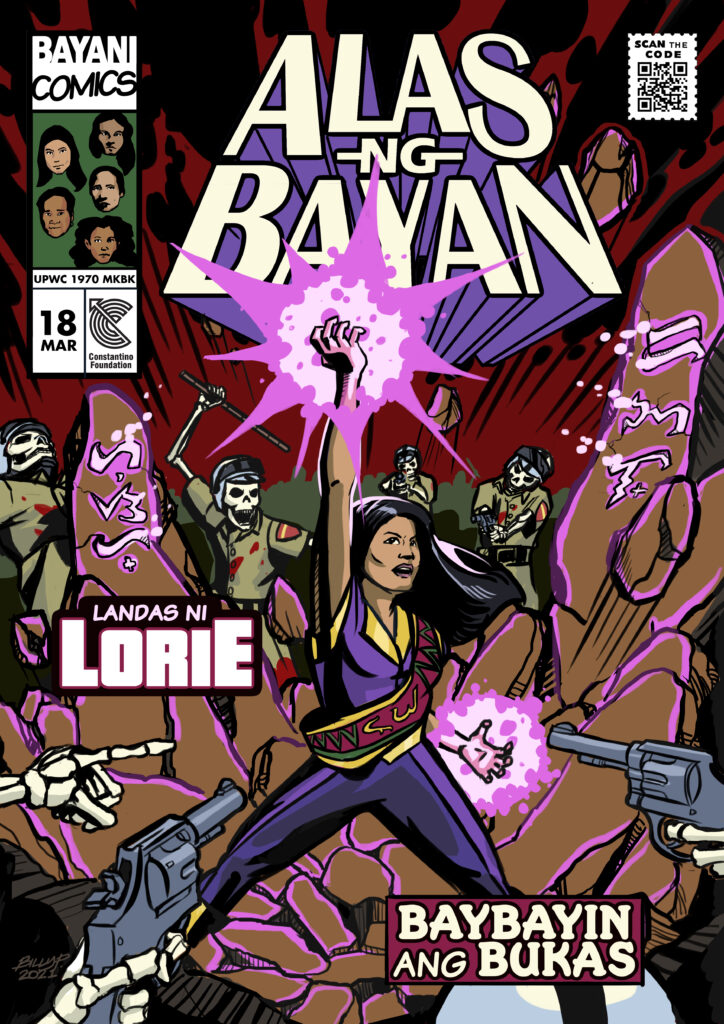
Maria Lorena Barros
Maria Lorena Barros (March 18, 1948-March 24, 1976) was the founding chair of Malayang Kilusan ng Bagong Kababaihan or MAKIBAKA. She was a writer and a student of history, a daughter, wife, and mother, a warrior and a poet. An anthropology graduate from UP Diliman, Barros joined the underground movement to fight the Martial Law dictatorship. In March 1976, she “was seriously wounded in an armed encounter with soldiers in … Mauban, Quezon… Medical treatment was promised by her captors if she would cooperate with them, but she said she would rather die for her beliefs. She was shot in the nape. She was 28 years old.”
Symbols and References
- MKBK: Barros was a member of the UP Writers Club, and the founding chair of MAKIBAKA. She graduated from UP Diliman in 1970.
- CONGRADS: Barros is wearing a maroon sash reminiscent of the sablay worn by UP graduates. Her uniform is also purple, which is a color associated with the feminist movement.
- DANGAL AT HUSAY: The baybayin on the rocks behind Barros spell out “Dangal” and “Husay,” the motto of UP.
- EARTHBENDING: Speaking of rocks, we decided to give Barros powers related to geomancy/earthbending because of the ideals she followed in life: Lorena being of the earth and the people who till it, and also a defender of the motherland as well.
- THE LIVING DEAD: When Billy first brought up the idea of undead Philippine constabulary, Duterte was president. Today, however, the ghouls of the past have literally clawed their way back into power in the form of the BBM presidency. If Billy and I had known just what the future had in store for everyone, maybe we would have added an extra lich or two in the background to further highlight the irony (and urgency) of our times.
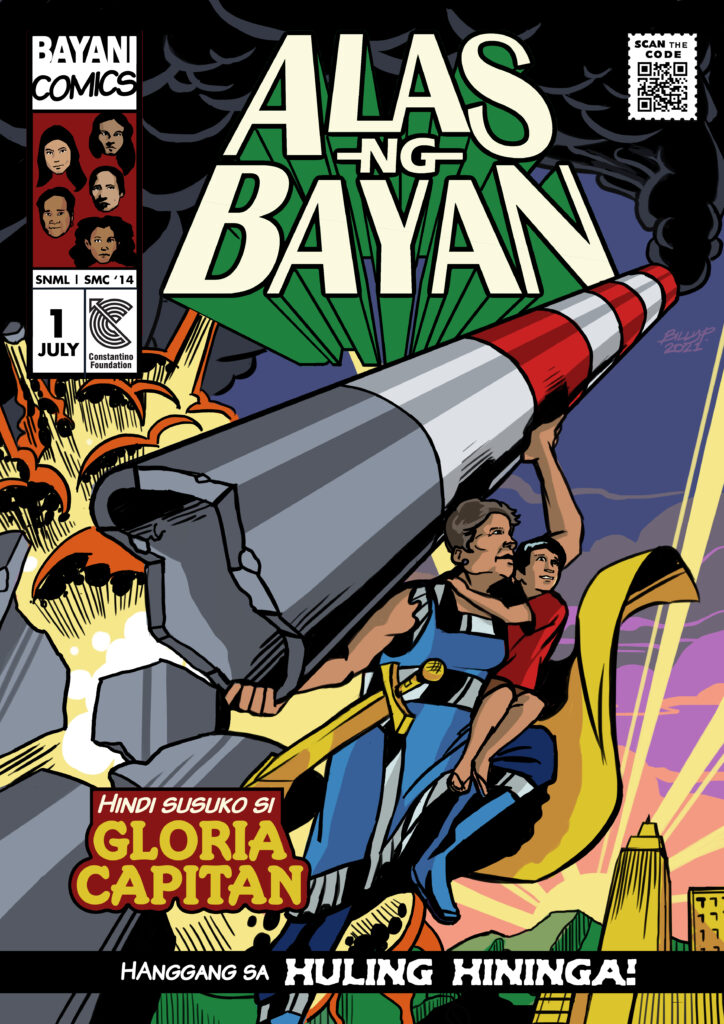
Gloria Capitan
Gloria Capitan was an anti-coal activist and human rights defender affiliated with the Coal-Free Bataan Movement. She was a former president of the Samahan ng Nagkakaisang Mamamayan ng Lucanin (SNML), a community-based organization that campaigned actively against the development of a coal plant and open coal storage facility in Barangay Lucanin, Mariveles, Bataan. Gloria was assassinated in her own videoke cantina by two unidentified gunmen on July 01, 2016, the very day President Duterte was sworn into office. Her death was the first recorded extrajudicial killing under the Duterte administration.
Symbols and References
- SNML | SMC: Gloria was the founder and former president of the SNML. In 2014, a coal stockpile operated by the Seafront Shipyard and Port Terminal Services, which supplied nearby coal plants, including one owned by the San Miguel Corporation (SMC) opened near her home. Dust from the stockpile almost immediately began contaminating Barangay Lucanin, outraging Gloria and eventually leading to the formation of the SNML.
- KARAOKE SWORD: Gloria loved to sing; one of her most beloved songs was “Ngayon at Kailanman” by Basil Valdez. Her karaoke store was one of her favorite places, and it was also the place of her assassination, where, according to her family, she was killed with no one but her grandchild and a stray black cat as witnesses.
- SUPER STRENGTH: Gloria was a strong woman. She built her family’s bahay kubo herself, cutting and sawing the wood and hammering in the nails with her own two hands, all so her family and the SNMLcould have a place for meetings.
- DUSTER: Gloria’s superheroine costume resembles a grandmother’s duster, because Gloria herself was a grandmother.
- HANGGANG SA HULING HININGA: Gloria risked death because she wanted her children and grandchildren to live full and healthy lives in a place with clean air. As SNML grew and Gloria joined rallies in Metro Manila, she learned more and more about climate change. Says Derek Cabe, who was with her during one protest: “She was crying beside me in the march — weeping. She said she didn’t know this thing was so big, so huge, compared to [her] problem, which is so little. She was inspired.”
The Artist

Basilio Pangilinan is a Quezon City-based illustrator whose primary medium is digital art. He is an alumnus of UP Diliman with a Bachelor of Science in Architecture. Basilio channels a lifelong inspiration from comic books into his art. His latest works explores the use of panelization from comic books to convey complex educational topics in science and aerospace Basilio has a focus on activism and protest art, an initiative that earned recognition from the Office for Initiative for Culture and the Arts during the 50th anniversary of Martial Law.He currently works as a junior designer at an urban planning and landscape firm, dedicating his free time to his illustration work.
What's New?
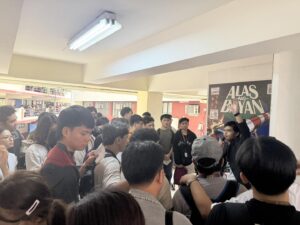
Alas Ng Bayan 2, opisyal nang inilunsad sa PUP Mabini Campus
Alas Ng Bayan 2, opisyal nang inilunsad sa PUP Mabini...
Read More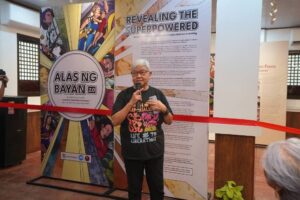
“Hindi krimen ang maging makabayan.” – Judy Taguiwalo
“Hindi krimen ang maging makabayan.” – Judy Taguiwalo Mensahe sa...
Read More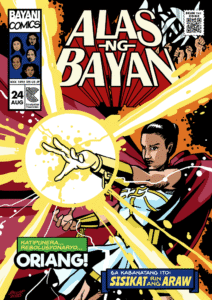
LAKAMBINI: When History Refuses to Stay Silent, by Cardinal Pablo Virgilo David (on a movie the Constantino Foundation encourages you to watch).
LAKAMBINI: When History Refuses to Stay Silent, by Cardinal Pablo...
Read More